

By Lena Milioni
You climbed the mountain and reached your goals. You have the job role you wanted and financial security. On the outside, your life looks impressive, even enviable. But inside, there’s a sense of something missing. A quiet disconnection. A haunting question: “Is this it… And now what?” You’re not alone—68% of high achievers report feeling unfulfilled despite success.
The Paradox of Achievement

Success should feel good—yet for many, it doesn’t.
Research shows that up to 72% of executives report feeling empty or let down after achieving significant milestones . This is known as the “success paradox”—a disconnect between outer accomplishments and inner fulfilment.
Part of the explanation lies in a psychological concept called the “hedonic treadmill.” Our brains are wired to quickly adapt to positive changes. That promotion, award, or major win gives us a temporary dopamine spike—but the sense of reward fades sooner than expected, prompting a return to baseline and often leaving us wondering: Why doesn’t this feel as satisfying as it should?
Signs You’re Experiencing Post-Achievement Emptiness
Meaning and Purpose Questioning
Persistent doubts about your life direction and meaning, despite having achieved your stated goals.
Emotional Disconnection
Accomplishments that should bring joy instead feel empty; celebrations feel performative rather than genuine.
Motivation Decline
Decreased drive despite maintained competence; tasks that once energised you now feel like going through motions.
High-Functioning Depression
Maintaining outward success while struggling internally—affecting approximately 15% of successful professionals.
The Psychology Behind Achievement Without Fulfilment
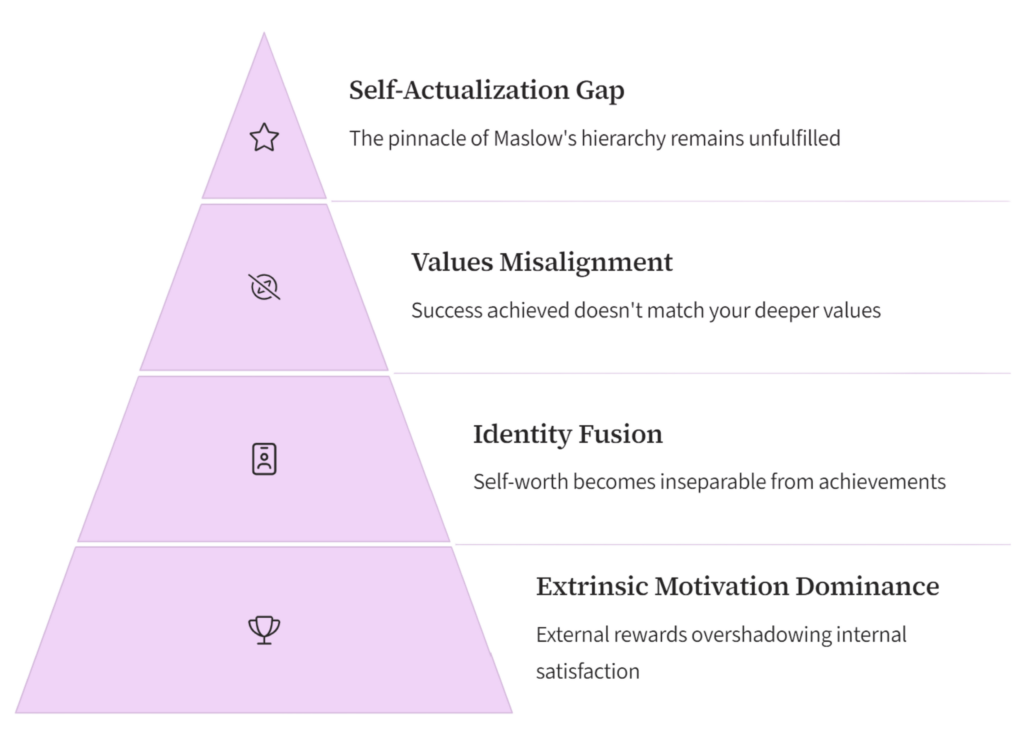
When Unresolved Past Experiences Hide Behind Success
For many high-achievers, the drive to succeed is not solely about ambition—it’s often a strategy for emotional survival. Behind the polished image of success may lie unresolved childhood experiences or trauma, which subtly shape a person’s identity, values, and coping mechanisms.
Psychological research and trauma-informed therapy frameworks suggest that early relational wounds can lead to internalized core beliefs such as:
- “I am not good enough.”
- “I must be successful to be worthy of love or respect.”
- “If I slow down, I will fall apart.”
- “If I fail, I am nothing.”
- “I am only valuable when I am achieving.”
In therapy, these unconscious patterns often emerge beneath the surface of burnout, emptiness, or identity confusion. Even after climbing the ladder, the sense of meaning remains elusive, because the inner child or traumatised self never felt truly seen, safe, or satisfied. Therapy helps individuals stop performing for worth and begin living with purpose.
Common Signs That Trauma May Be Underlying Post-Success Emptiness
- A persistent inner critic that downplays achievements
- Inability to feel joy or pride, even after major milestones
- Fear of stillness or rest, as if slowing down feels dangerous
- Chronic perfectionism or emotional numbness
- A deep sense of “not enough,” regardless of success
Therapeutic Interventions for Trauma-Rooted Emptiness
- Eye Movement Desensitisation and Reprocessing (EMDR)
Helps uncover and reprocess any potential early trauma driving perfectionism, achievement-based self-worth, or emotional avoidance. - Existential Therapy + Trauma-Informed Exploration
Supports clients in facing themes of mortality, isolation, freedom, and meaninglessness — often intensified by early unresolved pain. - Parts Work
Helps identify and integrate “inner parts” — like the performer, the critic, or the wounded child — so the self can lead with compassion and clarity. - Schema Therapy: Helps identify, understand and heal deeply ingrained maladaptive patterns (or “schemas”) formed in childhood, as well as how they shape their emotions, behaviours, and relationships in adulthood.
- Compassion-Focused Therapy (CFT)
Builds the capacity to soothe shame, self-judgment, and fear-based motivation with care, safety, and inner validation. - Somatic Approaches
Address trauma stored in the body, especially in high performers who often disconnect from emotion and live in “fight or flight” mode.
Therapeutic Approaches for High Achievers
| Therapeutic Approach | Key Benefit |
|---|---|
| Existential Therapy | Addressing emptiness and inner conflict, clarifying values and re-discovering purpose, meaning-making and reconstruction, reclaiming authenticity. |
| Cognitive Behavioural Therapy | Identifying and challenging core beliefs, addressing cognitive distortions, aligning actions with internal values, building emotional awareness and regulation, creating more sustainable routines. |
| Narrative Therapy | Externalising the problem, deconstructing dominant culture narratives, empowering identity reconstruction, creating meaning through storytelling. |
| Third-wave Cognitive Behavioural Therapies (e.g. Mindfulness-Based Cognitive Therapy, Acceptance and Commitment Therapy, Compassion-Focused CBT ) | Interrupting the achievement trap, enhancing presence and enjoyment, developing self-compassion, increasing emotional awareness and Regulation, accepting difficult feelings while committing to action, creating space for inner meaning. |
Creating a Personal Definition of Success
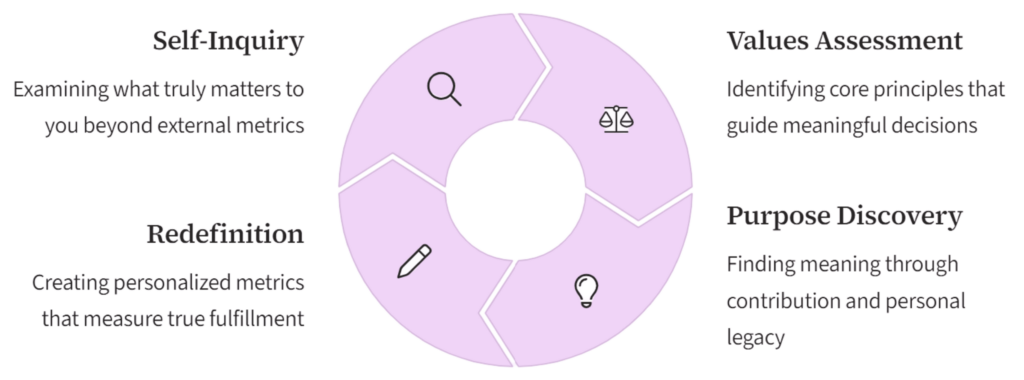
This therapeutic cycle helps high achievers separate societal expectations from authentic desires. The process reveals what success truly means to you—not what you’ve been conditioned to pursue.
Practical Steps to Reconnect With Yourself
Daily Reflection Practice
Implement clinically-proven mindfulness techniques that take just 10 minutes each morning. These practices create space between achievements and identity, fostering present-moment awareness.
Strategic Boundary Setting
Develop personalised work-life integration strategies that protect your energy and values. This includes digital boundaries, time allocation audits, and “non-negotiable” personal commitments and self-care.
Joy Cultivation
Identify and schedule small pleasures that reconnect you with immediate experience rather than future achievements. This rewires neural pathways to recognise fulfilment beyond accomplishments.
Relationship Deepening
Build connections based on authentic sharing rather than role-based interactions. This creates community outside of professional identity and achievement contexts.