

Most of us spend over 90,000 hours of our lives at work. Yet for many professionals, work feels like something to endure rather than embrace. This article explores the evidence behind meaning in professional life and how to cultivate it, even in roles that don’t feel like a calling.
The “Is That All There Is?” Moment
Consider a professional we’ll call Claudia. She’s competent, respected, and recently passed over for a pay rise that a different colleague received. She reflects: “I’m not passionate about this job, but I like that it provides me to do the things I love outside work.”
Claudia’s honesty is more common than we admit. She finds value in visibility, in learning, in human connection ….but struggles to name it as meaningful.
The question isn’t always “Am I passionate?” It’s “What genuinely matters to me here?”
This tension between what we do and what we wish we did is at the heart of professional meaning-making. And it is far more resolvable than most people believe.
What the Research Actually Says
Meaning Predicts Wellbeing
A landmark study by Steger & Dik (2010) found that meaningful work is one of the strongest predictors of life satisfaction, outperforming salary and status in long-term wellbeing outcomes.
Engagement Is Not the Same as Passion
Gallup’s State of the Global Workplace 2026 report consistently shows that fewer than 20% of employees feel engaged at work. A sense of purpose is a key driver of employee engagement. However, only 41% of employees strongly agree that their job is important to the organisation’s mission. Engagement, a sense of purpose and contribution, is distinct from passion, and far more attainable.
Research by Amy Wrzesniewski (1997) at Yale identifies three orientations to work: as a job, a career, or a calling. Meaning can be found in all three with the right lens.
The Hidden Meanings You Already Have
Claudia named several sources of satisfaction without recognising them as meaning. This is remarkably common. Meaning at work rarely announces itself; it hides in plain sight.
Feeling Indispensable
“They can’t do what I do without me.” The sense of being uniquely valuable is a legitimate and powerful source of professional meaning when recognised consciously.
Intellectual Curiosity
Learning about a subject deeply, even an unexpected one, engages the mind and builds mastery. Mastery is one of the three core drivers of intrinsic motivation (Ryan & Deci, 2000).
Human Connection
Daily interaction, networking, and being seen by others fulfils the fundamental need for relatedness. Connection at work is a direct buffer against burnout and disengagement.
Measurable Progress
“I want to see numbers ticking.” Tracking visible progress activates the brain’s reward system. Amabile’s research identifies this as the single most motivating daily experience at work.
When Childhood Writes Your Job Description
Some of the most powerful obstacles to finding meaning at work are not in the workplace at all; they are embedded in core beliefs formed in childhood. These beliefs act as invisible scripts that shape how we interpret every professional experience.
“Life is endurance.”
Work is something to survive, not enjoy. Rest or pleasure at work signals weakness. This belief often drives overwork and resentment while preventing authentic engagement.
“You always have to work hard to deserve anything.”
Achievements feel hollow because they were “supposed to happen.” Recognition from others is distrusted. Pay rises, like Claudia’s colleague received, feel unfair rather than aspirational.
“It’s just a job that pays my bills, don’t expect more.”
A defence mechanism that protects against disappointment. Over time, it suppresses ambition, creativity, and the very desire to find meaning — creating a self-fulfilling prophecy of disengagement.
“I need others to confirm my value.”
Validation-seeking becomes the primary driver at work. When clients are happy, self-worth rises. When they’re not, or when recognition is withheld, it crashes. This places identity entirely in external hands.
These beliefs are not character flaws. They were once adaptive responses to early environments. But they can be identified, examined, and changed, with the right support.
Interventions That Actually Work

The good news: meaning at work is not fixed. A growing body of psychological research supports several evidence-based approaches that help professionals reconnect with what matters and rewrite the scripts that hold them back.
Therapeutic & Coaching Approaches
Cognitive Behavioural Therapy (CBT)
CBT directly targets the negative core beliefs and cognitive distortions that undermine professional meaning. Techniques such as cognitive restructuring, behavioural experiments, and schema work help clients identify when they are filtering reality through a childhood blueprint and replace it with something more accurate and empowering.
Existential Therapy
Rooted in existential philosophy, this approach invites clients to explore questions of purpose, freedom, and responsibility. Rather than fixing symptoms, it helps professionals make conscious choices about what they want their work to mean particularly powerful during transitions or mid-career crises.
Acceptance & Commitment Therapy (ACT)
ACT helps clients clarify their core values and commit to action aligned with those values, even when the work itself feels imperfect. Rather than waiting to feel passionate, clients learn to act meaningfully now. Particularly helpful for those stuck in the “it’s just a job” trap.
Job Crafting
A research-backed technique developed by Wrzesniewski & Dutton: proactively reshaping your tasks, relationships, and cognitive framing at work to increase fit with your strengths and values. Claudia might craft her role to include more training, mentoring, or visible projects, without changing her job title.
Leadership Development and Coaching
For managers, meaning-focused leadership training builds the capacity to create psychological safety, articulate shared purpose, and recognise individual contributions, benefiting both the leader and their team’s engagement levels.
From Toxic Comparisons to Exploration and Curiosity
Comparison at work is almost universal, and most times painful. When a colleague is rewarded and we are not, the instinct is to feel overlooked. But beneath comparison often lies important information about our own unmet needs and unarticulated values.
What comparison usually signals
- Unrecognised contributions that matter to us
- A desire for visibility and validation
- Unspoken career ambitions we haven’t voiced
- Negative core beliefs, such as I am not capable or important enough
- Envy as data pointing toward what we actually want
A more curious question
Instead of “Why didn’t I get it?”, try: “What do I admire about how the person who got it shows up – his curiosity, his creativity, his courage, his drive to improve things? Which of those qualities am I not yet expressing fully in my own work? “How can I start expressing them starting from now?”
This reframe doesn’t dismiss the pain of being overlooked. It redirects energy from resentment toward agency — and that is where meaningful change begins.
A Practical Framework: Your Meaning Map
You don’t need a dramatic career pivot to find greater meaning at work. Start with honest self-inquiry. The following questions can be used as a Personal Meaning Map, a tool for grounding professional identity in something real.
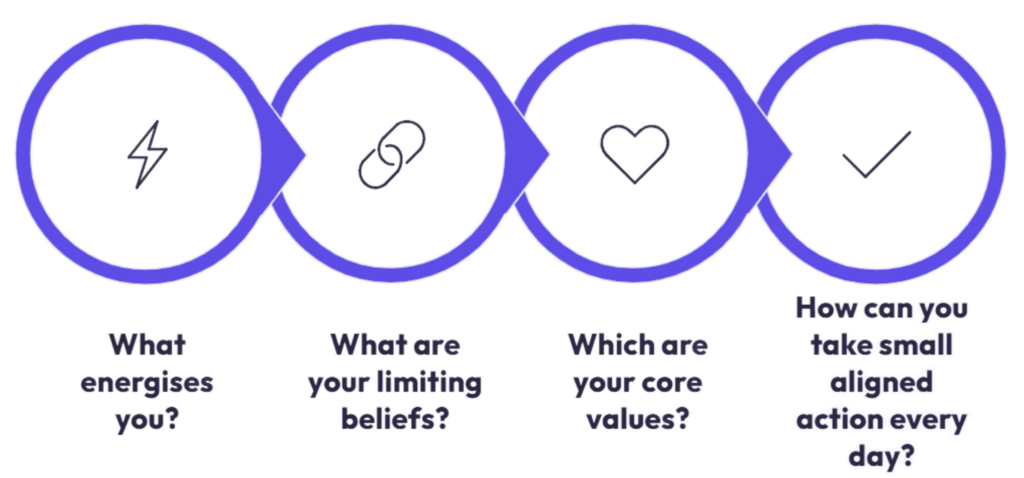
This process works whether you’re a senior leader navigating burnout, or a professional wondering why a colleague’s success stings more than it should. This map is about finding your direction.
Recommended tools: the VIA Character Strengths survey (viacharacter.org), the Job Crafting Exercise (MichiganRoss), and values-clarification worksheets used in ACT-based coaching.
Ready to Explore What Work Could Mean for You?
At Marylebone Psychological Therapies, we work with professionals and leaders who are asking the deeper questions about purpose, identity, and what they truly want from their working lives.
Our team offers evidence-based therapy and coaching including CBT, existential approaches, and trauma-focused work to help you understand your blueprint, the beliefs that may be quietly running the show, and to build a more authentic, meaningful professional life.
Book a Consultation
A confidential initial session to explore your goals and find the right approach for you.
Specialist Therapy
CBT, existential therapy, trauma-focused work and other approaches tailored to your professional context.
Visit us at https://marylebone-psychological-therapies.com/— because meaningful work isn’t a luxury. It’s a right worth pursuing.