

You’re checking emails at 10pm again. A client issue surfaced just before you switched off, and your mind is already composing the reply, running through solutions, pre-empting tomorrow’s fire before it even starts. You tell yourself it’ll only take a minute. An hour later, you’re still at your laptop — and somehow, the weight of the entire office seems to rest on your shoulders.
If this sounds familiar, you are far from alone. Many high-achieving professionals describe the same exhausting cycle: being the most reliable person in the room, absorbing others’ responsibilities, and quietly building a belief that this is simply what it takes to succeed. But there is a growing body of psychological evidence suggesting that this pattern — far from being a path to promotion — is a direct route to burnout, resentment, and a deeply distorted sense of self-worth.
This article is not about telling you to care less or work less hard. It is about understanding why you work the way you do, what it is costing you, and what evidence-based approaches can genuinely help you reclaim your evenings, your energy, and your sense of professional identity — without sacrificing your ambitions.
The Patterns Behind the Pressure
Before we look at solutions, it is worth naming what is actually happening, because the behaviours described above are rarely just about being “a hard worker.” They are rooted in a specific cluster of cognitive and emotional patterns that psychologists have studied extensively.
Hypervigilance at Work
Constantly scanning emails, pre-empting problems, and mentally rehearsing tomorrow’s challenges is a form of hypervigilance — a state of heightened alertness originally linked to threat perception. In workplace contexts, research by Cropanzano et al. (2017) found that employees with high conscientiousness and low perceived organisational support are significantly more likely to engage in after-hours cognitive rumination, which directly predicts emotional exhaustion.
Responsibility Absorption
The feeling that “the burden falls on the person who does it first” is a recognised dynamic in workplace psychology known as responsibility absorption. When one team member consistently covers for others, it creates an informal expectation that becomes self-reinforcing. Beck et al. (2015) describe this as a cognitive schema in which the individual begins to identify their core worth with their function, leading to chronic overextension.
Approval-Driven Performance
The desire to “fit in” and the belief that reliability is the route to promotion reflects approval-based motivation. Rather than being driven by intrinsic purpose, work becomes a mechanism for social acceptance and validation. Young and Klosko (1994), in their foundational work on schema therapy, identified this as the “subjugation schema” — where an individual suppresses their own needs in favour of others’ expectations to avoid conflict or rejection.
These are not character flaws. They are learned responses, often adaptive in earlier environments, that have become misaligned with the professional life you are trying to build.
The Negative Core Beliefs Driving the Cycle
At the heart of these patterns lie what cognitive behavioural therapy (CBT) calls negative core beliefs, ie. deeply held, often unconscious assumptions about oneself and the world. These beliefs feel like facts. They operate quietly in the background, shaping every workplace decision from whether to send that late-night email to whether you feel entitled to say no.
Research by Clark and Beck (2010) identified three dominant negative core belief clusters in high-functioning professionals experiencing burnout: beliefs about inadequacy (“I am not enough unless I prove myself”), beliefs about helplessness (“If I don’t do it, no one will”), and beliefs about worthlessness (“My value lies in what I produce, not who I am”).
“I Must Be Indispensable”
The belief that being the most reliable person protects your position. In reality, it often makes you invisible as a leader and visible only as an executor.
“If I Slow Down, Things Fall Apart”
A catastrophising belief that your vigilance is the only thing holding the system together. This keeps you locked in reactive mode and prevents strategic thinking.
“I Work Hard, Therefore I Deserve More”
An implicit transaction, effort exchanged for recognition, that rarely pays out in the way you hope, leading to chronic resentment.
“Saying No Means I Don’t Care”
The equation of boundaries with coldness or failure. This belief makes self-protection feel morally wrong, which is why boundaries feel so uncomfortable to enforce.
Recognising these beliefs is the first, and most significant, step. A 2019 meta-analysis by Linardon et al. confirmed that CBT-based interventions targeting negative core beliefs in occupational settings produced statistically significant reductions in burnout scores, anxiety, and interpersonal conflict over a 12-week period.
What the Research Says About Overwork and Mental Health
33% Increased risk for those working 55+ hours weekly (Kivimäki et al., 2015)
The evidence on chronic overwork is sobering, and it matters that you see it clearly, because the mind has a remarkable capacity to normalise what is slowly harming it. A landmark study by Kivimäki et al. (2015), published in The Lancet, followed over 600,000 workers across Europe and found that working more than 55 hours per week was associated with a 33% increased risk of stroke and a 13% higher risk of coronary heart disease compared to those working standard hours.
17 Million UK days lost to work-related stress and anxiety in 2022/23 (HSE)
Beyond physical health, the psychological toll is equally well-documented. A 2021 report by the World Health Organisation and International Labour Organisation estimated that 745,000 deaths per year are attributable to overwork globally, primarily through cardiovascular disease and stroke. In the UK specifically, the Health and Safety Executive (HSE, 2023) reported that work-related stress, depression, and anxiety accounted for over 17 million lost working days in 2022/23, with workload, lack of control, and interpersonal pressure being the three leading causes.
745,000 Global deaths attributable to overwork (WHO/ILO, 2021)
Critically, evening email checking, one of the most common behaviours among high-striving professionals, has been shown to significantly disrupt psychological detachment from work. Sonnentag and Bayer (2005) demonstrated that the inability to psychologically detach from work in the evenings was the single strongest predictor of morning fatigue, reduced job performance, and long-term burnout, more so than even total hours worked.
How to Set Boundaries — With Yourself First
The hardest boundary to enforce is never the one with your difficult colleague or your demanding boss. It is always the one with yourself. Because before anyone else can overextend you, you have already agreed to it internally — you checked the email, you took on the task, you stayed late, because somewhere in your belief system, it felt necessary or safer than not doing so.
Psychologist Henry Cloud, in his widely cited work Boundaries (Cloud & Townsend, 2017), distinguishes between reactive boundaries — rules you enforce in response to others’ behaviour — and proactive boundaries — decisions you make in advance, based on your values and wellbeing. Most professionals operate entirely in reactive mode, which is why boundaries always feel like conflict rather than self-respect.
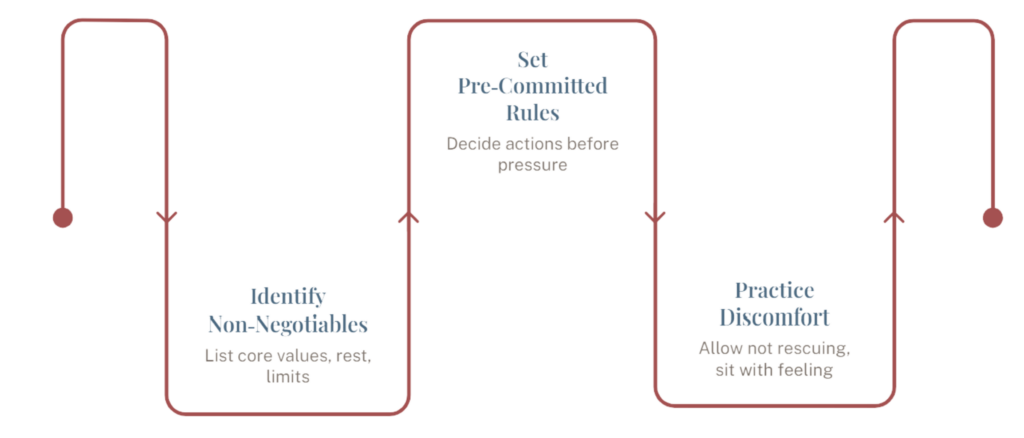
Practical starting points, grounded in the literature on self-regulation (Baumeister & Tierney, 2011), include the following. First, define a digital cut-off time — a non-negotiable hour at which work communications stop. This is not laziness; it is cognitive hygiene. Second, create a transition ritual between work and home life — even five minutes of deliberate activity (a short walk, writing three things completed that day) that signals to your nervous system that the workday is done. Third, practise the discipline of intentional incompleteness — accepting that some things will wait until morning, and that this is not a failure of character but a healthy acknowledgement of your humanity.
The goal is not to care less about your work. It is to care about it at the right times — and to reclaim the hours that belong to your life outside it.
Setting Boundaries With Others Without Burning Bridges
Once you have begun to work on internal boundaries, the interpersonal ones become more navigable, though no less uncomfortable, at least initially. The key insight from research on assertiveness training (Alberti & Emmons, 2017) is that boundaries communicated clearly and respectfully are almost always better received than the resentment and passive withdrawal that builds when we fail to voice them at all.
In team environments specifically, the dynamic of being the “reliable one who covers for everyone else” is rarely malicious on the part of colleagues — it is usually a structural or cultural problem that has never been named. Research by Hackman (2002) on team accountability found that in teams with unclear role expectations, the most conscientious individuals consistently absorb disproportionate workloads, not because others are lazy, but because the team system has never created accountability structures to distribute effort equitably.
Name the Pattern Without Blame
Raise the issue of workload distribution as a systemic problem rather than an individual accusation. “I’ve noticed that certain tasks tend to fall to whoever picks them up first; can we agree a clearer process?” shifts the conversation from conflict to problem-solving.
Use Specific, Time-Bounded Language
Rather than a vague “I’m overwhelmed,” try “I can take this on by Thursday but not by tomorrow, is that workable?” This is assertive without being aggressive, and it forces a real conversation about capacity.
Resist the Rescue Impulse
When a colleague fails to respond and you feel the pull to step in, pause and ask: “Is this mine to fix?” If the answer is no, practise leaving it. Allowing natural consequences to occur is not unkind, it is what creates the conditions for others to develop accountability.
Document and Escalate Strategically
If patterns of unequal workload persist, start keeping a quiet, factual record. This is not about building a case against colleagues but about having objective data when you raise the issue with management, which moves the conversation from subjective complaint to professional observation.
Protecting Your Mental and Emotional Health
Emotional exhaustion, the sense of being drained, depleted, and running on empty, is the core feature of burnout as defined by Maslach and Leiter (2016). It is distinct from tiredness. You can sleep eight hours and still wake up emotionally exhausted, because the depletion is not physical but relational and cognitive. It comes from the ongoing expenditure of emotional labour without adequate recovery or recognition.
Evidence-Based Recovery Strategies
Psychological Detachment: Sonnentag et al. (2010) demonstrated that deliberate psychological detachment from work during evenings and weekends, not merely physical absence but mental disengagement, is the strongest protective factor against burnout. This requires active practice, not passive intention. Strategies include scheduling non-work activities that genuinely absorb your attention, turning off notifications, and having a firm rule about which communications constitute genuine emergencies (almost none).
Self-Compassion Practice: Neff and Germer (2013) found that self-compassion, treating yourself with the same kindness you would extend to a struggling colleague, reduces burnout symptoms, increases work engagement, and improves interpersonal functioning. This is not a soft concept; it has robust neurobiological underpinnings, with studies showing measurable reductions in cortisol and inflammatory markers following compassion-based practices.
Daily Micro-Practices
01
Morning Intention Setting
Spend 5 minutes identifying your top 2–3 priorities. This counters the reactive mode that leaves you absorbing others’ agendas all day.
02
Midday Emotional Check-In
Ask yourself: “What am I feeling right now, and what does that tell me about what I need?” This builds the emotional self-awareness that prevents end-of-day depletion.
03
End-of-Day Wind-Down Protocol
Write a brief “done list” and identify one incomplete thing that can genuinely wait. Then close the laptop and do not reopen it.
04
Weekly Reflection
Review: Where did I absorb responsibility that was not mine? What did I feel good about? What would I do differently?
Research by Fritz et al. (2010) found that even brief, consistent recovery activities — as short as 10 minutes per day — produced measurable reductions in fatigue and increases in positive affect over a two-week period. Consistency matters more than duration.
Rethinking What Promotion Actually Looks Like
One of the most pervasive and damaging myths in professional culture is that reliability equals advancement. The belief that working hard, being indispensable, and always being available is the route to promotion is deeply held — and largely unsupported by organisational research.
A landmark study by Chamorro-Premuzic and Furnham (2010) examining leadership promotion patterns across multinational organisations found that the qualities most frequently rewarded with advancement were strategic visibility, influence, and the ability to develop others, not task execution, responsiveness, or hours worked. In fact, those who were perceived as essential to day-to-day operations were often overlooked for senior roles because they were seen as too valuable in their current function to be moved.
From Executor to Strategist
Promotion typically rewards those who see patterns and solve systemic problems, not those who handle the most individual tasks. Start contributing ideas, not just effort.
From Available to Influential
Being constantly available signals that you have capacity to absorb more work. Being selectively available, and deeply present signals confidence and control of your own time.
From Reliable to Trusted
Trust, in a leadership context, is built through honest communication about capacity, proactive problem identification, and the willingness to have difficult conversations, not through endless availability.
If promotion genuinely matters to you, and there is nothing wrong with ambition, the evidence suggests you need to shift from being the person who does the work to the person who shapes how the work gets done. That requires you to have more bandwidth, not less, which is another powerful reason to protect your time and energy with far greater intentionality.
Should You Change Jobs?
This is the question that quietly underpins everything and it deserves a thoughtful, honest answer rather than a reflexive yes or no. Because sometimes the answer genuinely is yes. But more often, the patterns and beliefs that are making your current role feel unbearable will follow you to the next one, unless they are addressed directly.
Wherever you go, there you are. A new job changes the environment. It does not automatically change the patterns you bring to it.
A useful framework here comes from organisational psychologist Edgar Schein’s work on career anchors (Schein, 1990), which suggests that professional dissatisfaction is rarely about a specific job — it is usually about a misalignment between your core values and the culture, structure, or role you are embedded in. Before making a change, it is worth asking a harder set of questions.
1. Is the Problem Situational or Systemic?
Is this role genuinely misaligned with your values and skills, or have you arrived at a point of burnout that would affect your experience in any role right now?
2. Have You Actually Asked for What You Need?
Many professionals leave jobs after years of absorbing frustration without ever having a direct conversation about workload, recognition, or growth. That conversation deserves to happen first.
3. What Specifically Would Be Different?
Can you articulate precisely what a better work situation would look like, ie. the culture, the team dynamics, the type of work, the management style? If not, the risk of repeating the same pattern elsewhere is high.
4. Are You Running Towards or Away?
Leaving because you are excited about something new is categorically different from leaving because you are exhausted by something now. Both are valid, but they require different preparation and carry different risks.
If, having sat with these questions, the answer is still that this environment is genuinely incompatible with your wellbeing — if the culture is toxic, the management is harmful, or the work is fundamentally misaligned with who you are — then leaving is not just valid; it may be essential. A 2022 meta-analysis by Rubino et al. found that prolonged exposure to high-demand, low-control work environments produced persistent psychological harm even after individuals left those roles. Your health is not negotiable.
Questions to Reflect On — A Starting Point for Change
Real change rarely begins with a dramatic decision. It begins with a quieter, more honest kind of attention, the kind you may not have been giving yourself lately, because all of your attention has been directed outward, towards the next email, the next crisis, the next person who needs something from you.
The following questions are not designed to give you answers immediately. They are designed to help you hear yourself more clearly, which is the foundation of every meaningful change. Write your responses down if you can. Return to them over time.
How to Set Boundaries
What is one boundary — with yourself or a colleague — that, if you enforced it consistently for one month, would most improve your daily experience at work? What belief is currently stopping you from doing so?
How to Protect Your Mental Health
When do you feel most like yourself at work — energised, clear, capable? What conditions make that possible? How much of your current working week looks like that, and what would need to change for it to be more common?
A Different Approach to Promotion
If the person who gets promoted is not the most available but the most strategic, what would it mean for you to start investing your energy differently? What one thing could you do this week that builds your influence rather than your task list?
The Bigger Question
Ten years from now, what kind of professional do you want to be, and what kind of life do you want to have built? Is the path you are currently on taking you towards that or further away from it?
You do not have to have the answers today. But the questions deserve your honest attention, and so do you. If these patterns feel deeply entrenched, working with a therapist trained in CBT or schema therapy can be profoundly effective. You do not have to navigate this alone.