
The Truth About Effective Therapy
The Integration Advantage
The most effective therapists don’t lock themselves into just one approach. Instead, they skillfully weave together different methods, creating a therapeutic experience uniquely designed for your needs, your story, and your goals.
Today, we’re exploring how three powerful approaches—Cognitive Behavioural Therapy (CBT), Eye Movement Desensitisation and Reprocessing (EMDR), and Existential Therapy (ET)—can work together to provide truly comprehensive mental health support that addresses your symptoms, your trauma, and your search for meaning all at once.
Cognitive Behavioural Therapy
Practical, structured approach focusing on thought patterns and behaviours
EMDR Therapy
Revolutionary trauma healing through bilateral brain stimulation
Existential Therapy
Meaning-focused exploration of life’s deeper questions
Why CBT Still Dominates (And Why That’s Both Good and Limiting)
If you’ve accessed therapy through the NHS, employee assistance programmes, or private health insurance, you were almost certainly offered CBT. And for good reason. CBT has decades of gold-standard research backing its effectiveness. It’s structured, time-limited, and focuses on measurable outcomes—things that appeal to healthcare providers, insurance companies, and people who want practical results fast.
1. Identify Unhelpful Thought Patterns
Recognise the thinking patterns that fuel distress and maintain psychological suffering.
2. Challenge and Reframe Thoughts
Develop more balanced perspectives with evidence-based cognitive restructuring.
3. Change Problematic Behaviours
Break cycles of anxiety, depression, or other symptoms through behavioural activation.
CBT is practical, goal-oriented, and designed to reduce symptoms relatively quickly. But here’s what CBT sometimes misses: Not all distress comes from “faulty thinking.” Sometimes, your pain stems from unprocessed trauma or grief, etc. Sometimes, it comes from feeling lost, purposeless, or disconnected from what makes life meaningful.
EMDR: The Trauma-Healing Game-Changer
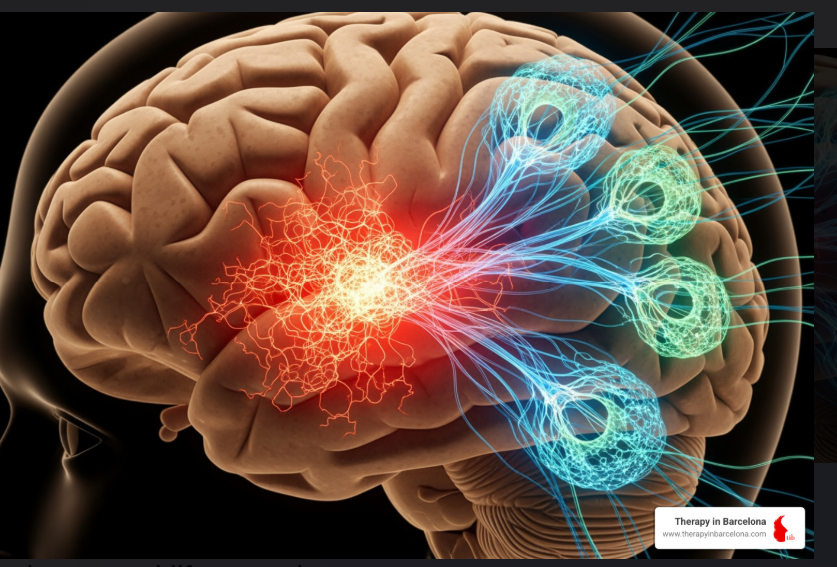
Eye Movement Desensitisation and Reprocessing (EMDR) has revolutionised how we understand and treat trauma. Unlike CBT, which works primarily through conscious thought examination, EMDR accesses the brain’s natural healing processes to reprocess traumatic memories that remain “stuck” in your nervous system.
When you experience trauma, your brain can fail to properly process the memory. Instead of becoming part of your integrated life narrative, the traumatic memories get stored in fragmented form, with the intense emotions, physical sensations, and beliefs you had at the time. This is why trauma survivors often feel like they’re reliving events rather than simply remembering them.
Bilateral Stimulation
Eye movements, tapping, or auditory tones activate both brain hemispheres.
Memory Reprocessing
Guided revisiting of traumatic material whilst engaging natural healing mechanisms.
Integration & Relief
Stuck memories become integrated, reducing nightmares, flashbacks, and emotional reactions.
The results can be remarkable: People who’ve carried traumatic memories for years, with nightmares, flashbacks, and intense emotional reactions, often find significant relief in relatively few sessions. But EMDR has its limits too. It’s extraordinarily effective for specific traumatic incidents, but what about ongoing existential distress? What about the depression that stems not from trauma but from feeling your life lacks purpose? This is where existential therapy enters the picture.
Existential Therapy: Going Beyond Symptoms to Meaning
Existential Therapy (ET) takes a fundamentally different approach from both CBT and EMDR. Rather than focusing primarily on symptom reduction or trauma reprocessing, ET explores the deeper questions of human existence. It views psychological suffering not as a malfunction to be eliminated, but as an inevitable part of being human, something that, when explored with courage and support, can actually lead to profound growth and self-understanding.
Meaning & Purpose
What gives your life meaning and purpose? How do you find direction when traditional sources feel empty?
Uncertainty & Limitations
How do you navigate life’s inherent uncertainties and the limitations of being human?
Freedom & Responsibility
What does freedom, choice, and responsibility mean to you in a world of constraints?
Connection & Mortality
How do you cope with isolation, mortality, and the fundamental aloneness of existence?
It’s less about “fixing” you and more about helping you make authentic sense of your reality and develop the capacity to navigate life’s inherent challenges with greater awareness and intention. Rather than seeing you as broken, existential therapy honours the full complexity of what it means to be human.
The Power of Integration: Finding Common Ground
At first glance, these approaches might seem incompatible, one is structured and symptom-focused, another is neurobiological and trauma-focused, and the third is exploratory and meaning-focused. But that’s exactly where integration becomes transformative. Despite their differences, CBT, EMDR, and ET share crucial similarities that make them powerful partners in comprehensive healing.
Meaning Matters
CBT has philosophical roots in Stoicism (our interpretations create our suffering). EMDR understands that the meaning you attach to traumatic events profoundly impacts how they affect you. ET places meaning-making at the very centre of psychological wellbeing.
Personal Agency
CBT empowers you to challenge unhelpful thoughts. EMDR activates your brain’s own healing capacity. ET emphasises your freedom to choose and take responsibility for your life. All three see you as an active participant in healing, not a passive recipient of treatment.
Working with Human Nature
Modern “third-wave” CBT approaches have moved toward accepting rather than just changing distress. EMDR trusts the brain’s inherent capacity to heal. ET honours the full complexity of human existence. All three work with, not against, who we naturally are.
What This Integration Looks Like in Real Therapy
So how does a skilled integrative therapist actually combine these approaches? Rather than having to choose between methods or rigidly applying one approach, integration creates a therapeutic space that draws on the strengths of each modality exactly when you need them. Here are concrete examples of integration in action:
1. EMDR with Existential Depth
When processing trauma with EMDR, an existential lens helps explore not just the memory itself, but the meanings and beliefs that formed around it. For childhood abuse, EMDR reprocesses traumatic memories whilst existential exploration examines beliefs like “I’m fundamentally unlovable” or “The world is dangerous.”
2. CBT Meets Existential Values
Rather than simply challenging “irrational” thoughts with “rational” ones, integration uses cognitive restructuring to identify beliefs that block you from living according to authentic values. “I can’t quit this job I hate” becomes an exploration of freedom, responsibility, and what truly matters.
3. EMDR Preparation with CBT Skills
EMDR requires sufficient emotional regulation before processing trauma. CBT techniques build this capacity: learning grounding techniques, developing emotion regulation skills, creating your “container” for distressing material, exploring your strengths and resources—ensuring you have tools for safe trauma work.
4. Downward Arrow Reveals Existential Concerns
CBT’s technique of repeatedly asking “What does that mean?” uncovers not just cognitive schemas, but deeper existential concerns. “I’m anxious about this presentation” may lead down to core fears about isolation, responsibility, authenticity or meaninglessness.
5. Holistic Case Formulation
Instead of forcing a choice, integrative therapists create comprehensive formulations: What thought patterns maintain distress? What adverse life experiences need reprocessing? What deeper concerns about meaning, freedom, or mortality are present? Everything gets acknowledged.
Why This Integration Matters for Your Healing Journey
If you’re seeking therapy or currently working with a therapist, an integrative approach offers profound benefits that single-modality therapy simply cannot provide. Integration means you never have to choose between immediate relief and long-term transformation, between healing old wounds and building new meaning, between practical coping and authentic living.
Immediate Relief AND Long-Term Transformation
Work on reducing acute symptoms through CBT, process trauma through EMDR, and explore meaning through existential work. You don’t have to choose.
Trauma-Informed AND Meaning-Focused
Heal traumatic wounds whilst simultaneously exploring questions of purpose, values, and authentic living. Both matter.
Tailored to Where You Are
Some days you need practical coping strategies. Other times you’re ready for trauma processing or exploring big questions. Integration meets you exactly where you are.
Addresses Root Causes
Anxiety might stem from unprocessed trauma, catastrophic thinking, and avoiding authentic choices. Integration addresses all levels, not just symptoms.
Culturally Responsive
Integration honours your cultural background, values, and unique lived experience rather than forcing you into a rigid theoretical box.
Builds Lasting Resilience
Symptom-focused work provides immediate relief, trauma processing heals wounds, and existential exploration builds capacity to navigate future challenges.
Real-World Example: Depression After Job Loss
Imagine you’ve lost your job and are experiencing depression. Integration creates comprehensive healing by addressing multiple dimensions of your experience simultaneously, ensuring nothing important gets overlooked.
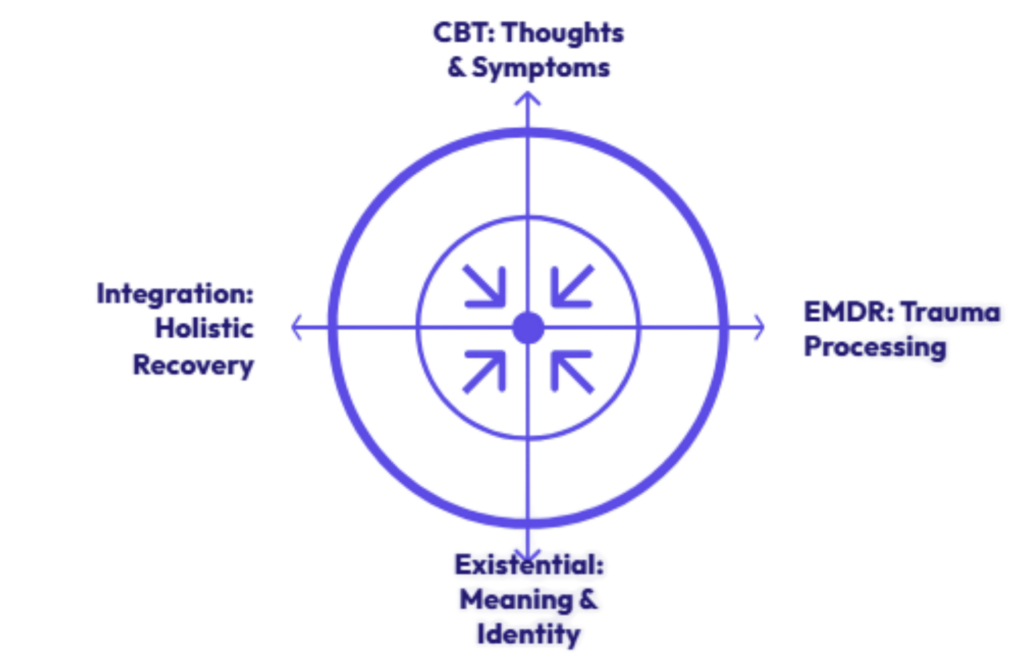
The integration creates comprehensive healing: symptom relief, trauma resolution, and an opportunity to rebuild your life with greater intention and meaning.
CBT Helps You
- Challenge catastrophic thoughts (“I’ll never be able to find a job again”)
- Address behavioural withdrawal
- Develop coping strategies for job searching anxiety and interviews
- Build practical problem-solving skills
CBT Helps You
- Challenge catastrophic thoughts (“I’ll never be able to find a job again”)
- Address behavioural withdrawal
- Develop coping strategies for job searching anxiety and interviews
- Build practical problem-solving skills
EMDR Addresses
- Traumatic aspects of the job loss itself
- Earlier experiences of rejection or failure this event has triggered
- Stuck memories maintaining distress
- Physical and emotional activation patterns
Existential Therapy Explores
- What this loss means for identity and purpose
- Who you are beyond your career
- What truly matters to you
- How to move forward authentically
Finding Your Integrative Therapist
If this approach resonates with you, you deserve comprehensive care that honours the full complexity of your human experience. The therapists who can help you most effectively are those who draw on multiple evidence-based approaches, use clinical judgement to create therapy uniquely suited to you, address your symptoms, your trauma, and your search for meaning, and see you as a whole person, not just a diagnosis.
Questions to Ask Potential Therapists
- How do you integrate different therapeutic approaches?
- Do you adapt your methods based on what each client needs?
- How do you balance symptom relief with deeper exploration?
Red Flags
Therapists who dismiss other approaches as “unscientific” or insist their single method works for everyone. Rigidity and dismissiveness are warning signs.
Green Flags
Therapists who are curious about your unique situation, discuss collaborating to find what works for you, and have training in multiple modalities. Flexibility and openness are key.
Look for practitioners trained in multiple modalities (CBT or third-wave approaches, like DBT, ACT, MBCT; EMDR; Existential therapy; Schema therapy). Ask about their training, their flexibility, and their philosophy of integration. The right therapeutic fit can make all the difference between merely managing symptoms and truly transforming your life. You deserve therapy that not only helps you feel better but also supports you in healing from the past and becoming who you genuinely want to be.