

by Lena Milioni
The Existential Nature of Grief

If you’ve experienced the death of a loved one, you’ve likely wrestled with questions like “Why now?” or “How do I move on from this?“, “Why did it happen to me?” Grief is not just an emotional reaction, it’s an existential one.
As a psychotherapist and someone who has lost both parents in a period of two years apart, I’ve come to realise that bereavement is not something we “get over.” It changes the way we see ourselves, others, and the world around us. And yet, within this painful disruption lies a strange and quiet opportunity: to live more deeply, more authentically, and perhaps even more meaningfully.
Death: The Inescapable Companion of Life
Existential thinkers have long pointed out a paradox we all must face: we deeply desire life, yet we’re bound by death. Philosopher Irvin Yalom named death one of the “ultimate concerns” of existence, alongside freedom, isolation, and meaninglessness. According to him, it’s not death itself that terrifies us , it’s the idea of not having lived fully.
Being-towards-death
Heidegger described this as the idea that we live each moment under the shadow of our mortality. While that might sound bleak, it’s also what gives our days their weight, urgency, and potential for meaning.
Life’s Weight
Death doesn’t just show up at the end. It’s woven into life. This awareness can transform how we approach each day, pushing us to prioritise what truly matters rather than putting off meaningful experiences.
Grief as an Existential Earthquake
Grief can feel like being cut adrift from the world. After my mother (and two years later, my father) died, I experienced a strange kind of disorientation and rootlessness, a sense that nothing around me quite made sense anymore. I was going through the motions, but part of me felt suspended, disconnected. If you’ve been there, you know it’s not just sadness. It’s as though time and self have been cracked open.
Research and existential theory both confirm this: losing a loved one isn’t just about missing someone. It’s about your identity, your worldview, your sense of safety — all thrown into question.

The Evolution of Grief
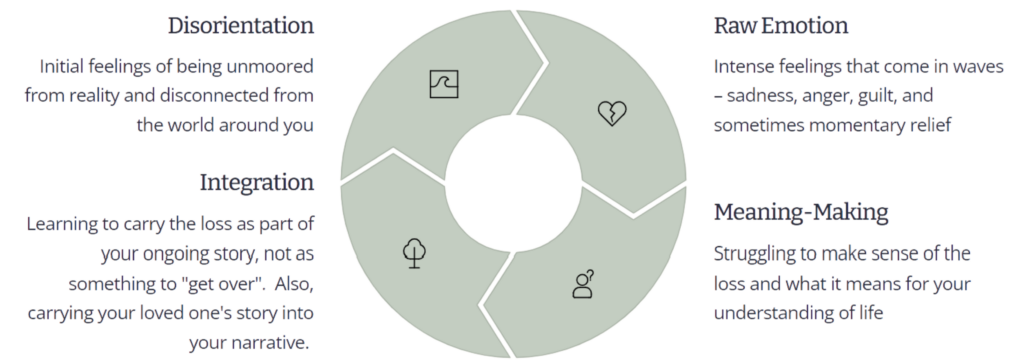
There’s no fixed roadmap through this. No tidy end point. Grief doesn’t “resolve.” It evolves. Some days you may feel more whole, and on others, the absence feels fresh again. It’s not about closure, it’s about learning to carry the loss as part of your story.
Therapy as a Space to Rebuild
In existential psychotherapy, we don’t try to erase grief. We honour it. We sit with the difficult questions: Who am I without them? What does this loss say about my place in the world ? How can I live meaningfully after such pain?
This approach encourages you to explore how the loss has impacted every layer of your existence — physically, emotionally, socially, and spiritually. It doesn’t prescribe a formula but invites you to engage in meaning-making. You may find new values, redefine priorities, or reimagine your identity in the aftermath of loss.
Sometimes, we also explore dreams, spiritual and cultural beliefs, or even the way you now relate to the deceased. Some people describe having an ongoing inner dialogue with the person they’ve lost, continuing the relationship in a different form.

Therapeutic Approaches to Grief
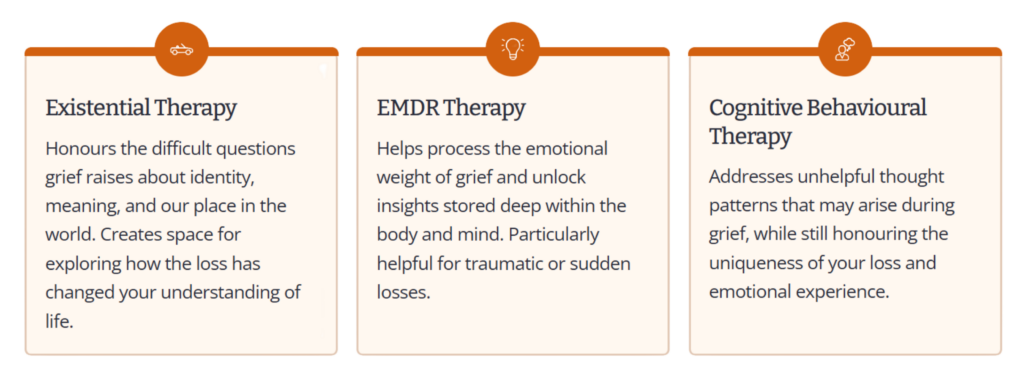
As a therapist, I believe in balancing existential depth with therapeutic flexibility. Integrating these approaches can offer powerful support while honouring the unique story of your loss.
Embracing the Paradox
To live fully, we must be willing to face death — not as a morbid fixation, but as a way of anchoring ourselves in what really matters. That might sound simple, but it’s not easy. We may need to let go of old versions of ourselves or confront uncomfortable emotions we’d rather avoid.
But when we allow ourselves to feel the pain, to sit with the discomfort, something unexpected happens. Joy becomes more vivid. Gratitude more potent. We notice the little things — a warm cup of tea, a kind word, the light shifting through the trees- and feel connected.
These moments don’t erase grief, but they sit alongside it, offering a kind of quiet redemption. This is the paradox of grief: that profound loss can open the door to profound appreciation.
A Personal Reflection
As I continue processing my own loss, I’ve come to see that my parents live on — not only in memory but in the values they passed down and the way I now show up in the world. Their absence is real, and yet, so is their presence.
My grief journey has taught me that the bond with those we’ve lost doesn’t simply end—it transforms. I find my parents in unexpected places: in my own gestures and facial expressions, in the wisdom I now share with others, in the way I’ve learned to appreciate simple moments that I might have once overlooked.
The pain of their absence remains. There are still days when I reach for the phone to call them, only to remember I can’t. But alongside this sadness is a deeper appreciation for the time we had and the ways they shaped me.
Grief has taught me that we don’t move on from love. We move with it.
A Call to Presence
If you’re grieving, know this: you are not broken. Your pain is not something to be fixed but something to be felt, witnessed, and understood. Loss asks you to live differently — not less — and to find meaning, purpose and growth not in spite of your grief, but through it.
In the end, death reminds us that life is precious — not because it’s perfect, but because it ends. And that, in itself, is what makes it beautiful.